
Urban Densification Remains Key

Colonnade BridgePort CEO Hugh Gorman says infill and building where amenities already exist just makes sense as a solution to Ottawa’s housing shortage.

By Colonnade BridgePort
Written for Ottawa Business Journal’s Executive Report on Homes + Construction
November 2026
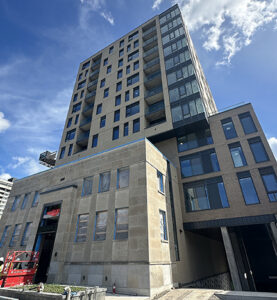
A photo of CBP's 12-storey Artefact on Argyle set to welcome residents in Jan 2027
CBP’s Artefact on Argyle is set to welcome residents in January 2027

Housing was the single biggest issue discussed by residential development leaders who gathered for the Ottawa Business Journal’s executive roundtable on homes and construction, according to Hugh Gorman.

The CEO of Colonnade BridgePort says the City of Ottawa has initiated plenty of good work on the housing file, starting with the Housing Innovation Task Force last year, and, subsequently, the implementation of outcomes from it. The new official plan, new policy on development charges, and efforts to encourage infill development are also positive steps, Gorman says.

“Those are all things that we, as an industry, should be applauding,” he adds. “But one thing that came up at the roundtable is that, from an approval standpoint, the time to process files is still very, very slow. I would concur with that. There is still significant work to be done to streamline the approval process and shorten timelines.”

Gorman concludes that there are good things happening on the policy side, but the execution side still leaves “some room for improvement.”
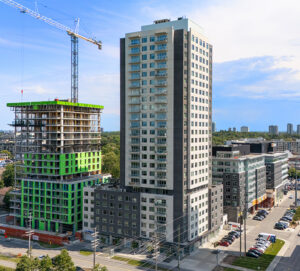
Photo of 1950 and 1960 Scott Street. Multi-residential towers build by CBP.
RYSE, left, located at 1950 Scott Street, is under construction beside CBP’s first multi-residential tower as part of Westboro Connection, which was completed in 2020.

As a full-service real estate investment, property management and development company, Colonnade BridgePort (CBP) stands to gain from such improvements. That’s because the company’s approach to multi-family housing has always been to build urban infill along transit lines.

That’s been our strategy since the beginning,” Gorman says. “We felt there was opportunity inside the Greenbelt along the LRT to add much needed new housing in established amenity rich communities. And this housing utilizes existing infrastructure, minimizing the need for new infrastructure like roads and transit and new pipe in the ground for water and sewer.”

CBP’s approach has always been to make better use of existing infrastructure by adding density that supports established communities and businesses, while recognizing that greenfield development also has a role to play in meeting the city’s broader housing needs. “But we need more intensification and urban infill,” he says. “And people’s requirements for housing are                                                                                     evolving as our population grows.”

He says downtown revitalization, for example, requires more people living in the core – and while people are learning to accept smaller spaces, urban renewal will invest in community centres, parks and recreation facilities to attract families. “That’s critical,” Gorman says, pointing to LeBreton Flats as an example. “If people are living in smaller accommodation, they need places to go outside their units.”

On transit, he says he believes the kinks will be worked out over time.

“Once they are, the LRT will have a significant effect,” he says. “We have to be patient, but I have to believe that with time, the right expertise, leadership and processes will be in place. Everyone needs to focus on working solutions, not politicizing this.”

“We believe in Ottawa and we’re excited by the assets Ottawa has, from the stability of the government to all the educational facilities and research and development.”

As confirmation of its bullishness on Ottawa, CBP alongside its partners has invested more than $500 million in 868 units currently under construction.

Colonnade BridgePort CEO Hugh Gorman says infill and building where amenities already exist just makes sense as a solution to Ottawa’s housing shortage.

By Colonnade BridgePort
Written for Ottawa Business Journal’s Executive Report on Homes + Construction
November 2026
A photo of CBP's 12-storey Artefact on Argyle set to welcome residents in Jan 2027
CBP’s Artefact on Argyle is set to welcome residents in January 2027

Housing was the single biggest issue discussed by residential development leaders who gathered for the Ottawa Business Journal’s executive roundtable on homes and construction, according to Hugh Gorman.

The CEO of Colonnade BridgePort says the City of Ottawa has initiated plenty of good work on the housing file, starting with the Housing Innovation Task Force last year, and, subsequently, the implementation of outcomes from it. The new official plan, new policy on development charges, and efforts to encourage infill development are also positive steps, Gorman says.

“Those are all things that we, as an industry, should be applauding,” he adds. “But one thing that came up at the roundtable is that, from an approval standpoint, the time to process files is still very, very slow. I would concur with that. There is still significant work to be done to streamline the approval process and shorten timelines.”

Gorman concludes that there are good things happening on the policy side, but the execution side still leaves “some room for improvement.”

Photo of 1950 and 1960 Scott Street. Multi-residential towers build by CBP.
RYSE, left, located at 1950 Scott Street, is under construction beside CBP’s first multi-residential tower as part of Westboro Connection, which was completed in 2020.

As a full-service real estate investment, property management and development company, Colonnade BridgePort (CBP) stands to gain from such improvements. That’s because the company’s approach to multi-family housing has always been to build urban infill along transit lines.

That’s been our strategy since the beginning,” Gorman says. “We felt there was opportunity inside the Greenbelt along the LRT to add much needed new housing in established amenity rich communities. And this housing utilizes existing infrastructure, minimizing the need for new infrastructure like roads and transit and new pipe in the ground for water and sewer.”

CBP’s approach has always been to make better use of existing infrastructure by adding density that supports established communities and businesses, while recognizing that greenfield development also has a role to play in meeting the city’s broader housing needs. “But we need more intensification and urban infill,” he says. “And people’s requirements for housing are                                                                                     evolving as our population grows.”

He says downtown revitalization, for example, requires more people living in the core – and while people are learning to accept smaller spaces, urban renewal will invest in community centres, parks and recreation facilities to attract families. “That’s critical,” Gorman says, pointing to LeBreton Flats as an example. “If people are living in smaller accommodation, they need places to go outside their units.”

On transit, he says he believes the kinks will be worked out over time.

“Once they are, the LRT will have a significant effect,” he says. “We have to be patient, but I have to believe that with time, the right expertise, leadership and processes will be in place. Everyone needs to focus on working solutions, not politicizing this.”

“We believe in Ottawa and we’re excited by the assets Ottawa has, from the stability of the government to all the educational facilities and research and development.”

As confirmation of its bullishness on Ottawa, CBP alongside its partners has invested more than $500 million in 868 units currently under construction.